

Musculoskeletal pain

Neck pain in Singapore: causes, tests and treatment

Most neck pain settles with time and simple measures. If it lasts, spreads into your arm, or is affecting your work or sleep, a pain specialist can find the cause and plan treatment with you.

At a glance

Common signsAching, stiffness or tightness in the neck, sometimes with pain into the shoulder, arm or head, and difficulty turning your head.
See a specialist ifNeck pain has lasted more than a few weeks, keeps coming back, spreads into your arm, or is limiting your work or sleep.
What may helpStaying active, guided exercise, pain relief and, for persistent pain, a targeted injection or nerve treatment.
Seek urgent care forNeck pain with fever and a stiff neck, new weakness or numbness in the limbs, or pain after a serious injury or fall.
Written and reviewed by Dr Christopher Liu, Pain PhysicianLast reviewed: 27 October 2026About Dr Liu

What is neck pain?

Neck pain is pain felt in or around the neck. It can spread to the shoulders, upper back, head or arms. It is very common: an estimated 203 million people worldwide had neck pain in 2020, and it is more frequent in women and in middle age.1

Most episodes improve over days to weeks, but some people have pain that lasts for months or keeps coming back.2 Often the pain comes from the muscles, ligaments and small facet joints at the back of the neck, and no single injury can be found. In other people an irritated or pinched nerve in the neck (cervical radiculopathy) causes pain that travels into the arm.

What causes it?

Neck pain has many causes, and more than one is often involved:

  • strain of the neck and shoulder muscles and ligaments, for example from long hours at a desk or on a phone, or from awkward sleeping positions
  • age-related wear of the discs and joints of the neck (cervical spondylosis)
  • irritation of the small facet joints at the back of the neck
  • a pinched or irritated nerve from a bulging disc or bony narrowing
  • injury, including whiplash
  • stress and tension, which can tighten the neck and shoulder muscles

Less commonly, neck pain is a sign of infection, inflammatory arthritis or other serious conditions, which is why a proper assessment matters.

Symptoms

Typical features include:

  • aching, tightness or stiffness in the neck, often worse with certain movements or after long periods in one position
  • difficulty turning the head, for example when checking your blind spot while driving
  • tender, tight knots in the muscles of the neck and upper back
  • headaches that start at the back of the head and neck
  • pain, tingling, numbness or weakness in the shoulder, arm or hand if a nerve is involved

Seek urgent medical care if you have neck pain with:

  • fever, a stiff neck and headache, or a new rash
  • new weakness or numbness in both arms or legs, difficulty walking, or loss of control of your bladder or bowels
  • severe pain after a fall, accident or other significant injury
  • chest pain or breathlessness, or a sudden severe headache with weakness, slurred speech or vision loss

Go to the nearest emergency department.

When should you see a pain specialist?

Consider an assessment if:

  • neck pain has lasted more than a few weeks or keeps coming back
  • pain spreads into your arm or hand, or you have tingling or numbness
  • neck pain or neck-related headaches are interfering with your work, lifestyle or sleep
  • medicines and physiotherapy have not given you enough relief
  • you would like a clear explanation of the cause and a plan for treatment

How is it diagnosed?

Diagnosis starts with your history and an examination of the neck, shoulders and arms, including a check of strength, sensation and reflexes. Most neck pain does not need a scan. An X-ray, MRI or CT is considered when there are warning signs, when nerve symptoms are not settling, or when an injection or procedure is being planned.2 Scan changes are common in people with no pain, so the findings are always read together with your symptoms and examination.

When pain is thought to come from the facet joints, a small local anaesthetic injection near the nerves that supply the joint (a medial branch block) can help confirm the source before a longer-lasting treatment is considered.

How is it treated?

Treatment depends on the cause and on how long you have had the pain. Many people improve with simple measures, and procedures are considered when pain persists or nerve symptoms are significant.

  • Stay active. Gentle movement within comfort is usually better than rest or a neck collar.
  • Guided exercise, usually with a physiotherapist, to improve neck and shoulder strength and mobility.
  • Posture and workstation changes to reduce strain from prolonged sitting or phone use.
  • Pain medicines, including anti-inflammatory and nerve-pain medicines, used as advised by your doctor.
  • Trigger point injections for tight, tender muscle knots that contribute to neck pain. They are often helpful for people with myofascial pain syndrome or neck pain from muscle strain.
  • Epidural steroid injection or nerve root block, placed under X-ray guidance, to reduce inflammation around an irritated nerve that is causing pain into the arm. These injections can help with conditions such as herniated discs, cervical stenosis or radiculopathy.
  • Facet joint injection to ease pain from inflamed facet joints.
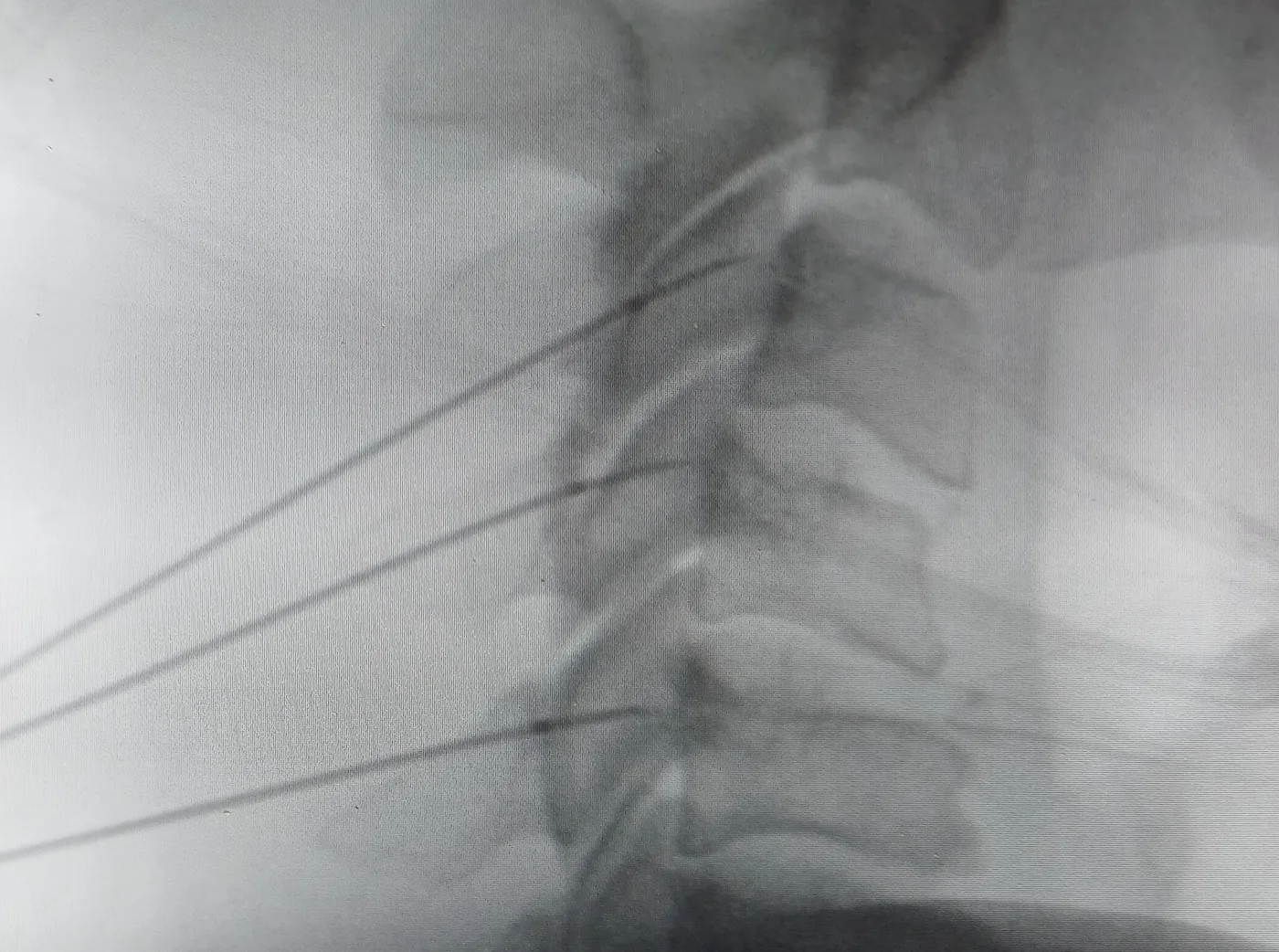
  • Radiofrequency ablation of the facet joint nerves, considered when diagnostic blocks show the joint is the source of pain. Radiofrequency ablation is a minimally invasive technique for neck pain due to facet joint problems. Relief can last for months in people who respond, but the nerves can regrow, so pain may return and the treatment can sometimes be repeated.
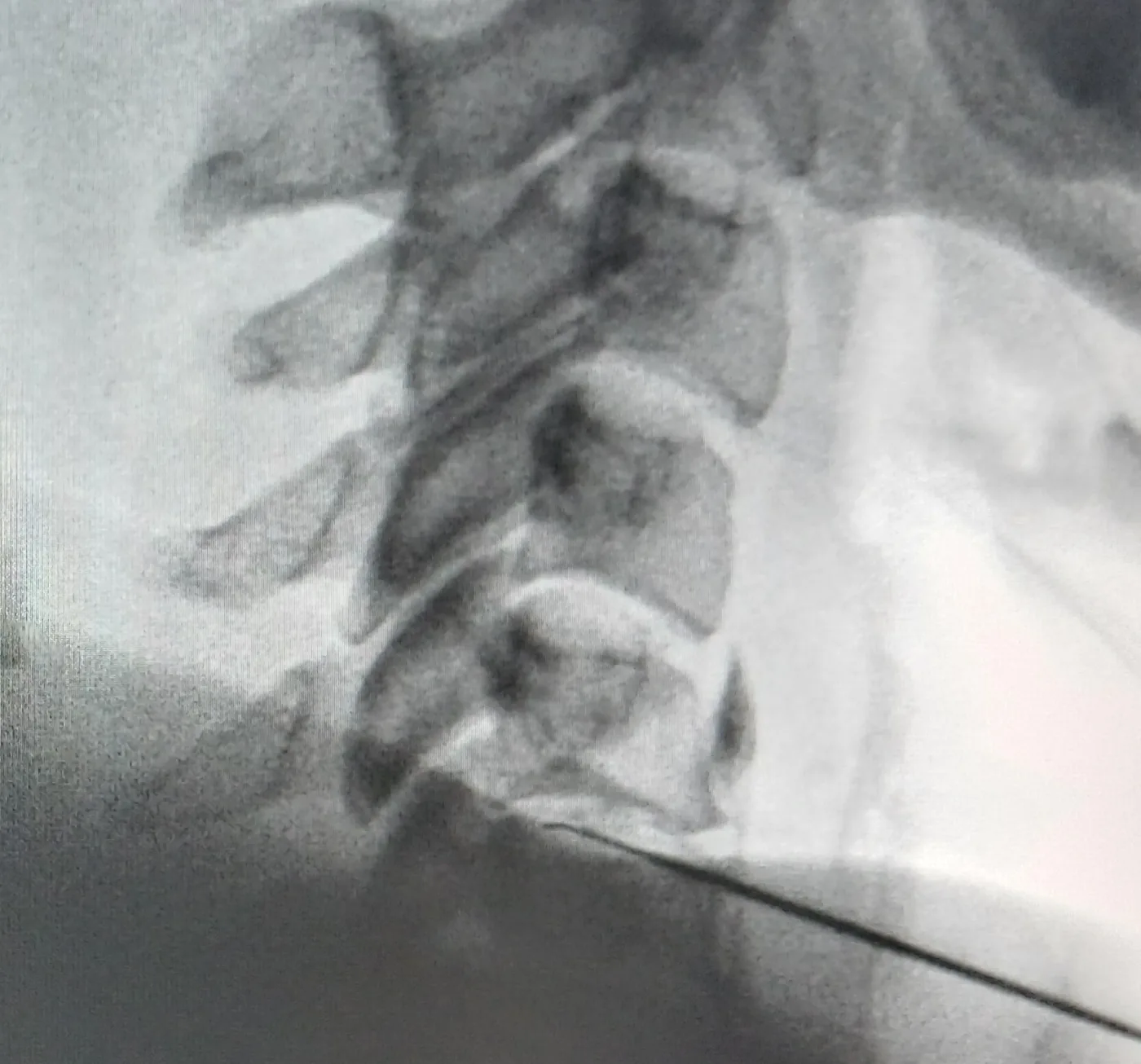
  • Nucleoplasty (an intradiscal procedure) may be considered for selected people with neck and arm pain from a contained disc bulge when other treatments have not helped.

Surgery is rarely needed and is usually reserved for significant nerve or spinal cord compression.2

X-ray image of the neck from the side, with needles positioned beside the cervical facet joints during radiofrequency ablation
X-ray (fluoroscopy) image taken during a cervical facet radiofrequency procedure. The needles are placed next to the nerves that supply the facet joints.
X-ray image of the neck from the side, with a needle guided towards a cervical disc during nucleoplasty
X-ray (fluoroscopy) image taken during a cervical nucleoplasty. The needle is guided into the disc under X-ray.

What to expect at your visit

At your consultation at our neck pain clinic in Farrer Park Hospital, Dr Liu will ask about your symptoms, your work and daily activities, and your medical history, and examine your neck, shoulders and arms. He will explain what he finds, discuss whether any tests would help, and go through your treatment options, including their benefits, limits and risks, so that you can decide what suits you. Many people start with exercise and medicine, and if an injection is suitable we will explain what it involves.

You do not have to put up with neck pain. Many people improve with the right treatment, and our aim is to ease your pain so that you can get back to the things you enjoy. Book a consultation and we will work out a plan with you.

Looking after your neck

  • Keep moving your neck gently within a comfortable range. Avoid keeping it completely still.
  • Set up your workstation: screen at eye level, feet supported, and a short break from sitting every 30 to 45 minutes.
  • Raise your phone towards eye level instead of looking down for long periods.
  • Choose a supportive pillow that keeps your neck in a neutral position when you sleep.
  • Do your exercises regularly. Short, frequent sessions are usually better than occasional long ones.
  • Make time to relax. Stress often tightens the neck and shoulder muscles.
Dr Christopher Liu, pain physician at Alleviate Pain Clinic

Dr Christopher Liu, Pain Physician

MOH accredited Pain Specialist and Medical Director of Alleviate Pain Clinic at Farrer Park Hospital. He completed an interventional pain fellowship at the University Health Network in Toronto and was previously a Senior Consultant in Pain Medicine at Singapore General Hospital.

Read more about Dr Liu

References

  1. GBD 2021 Neck Pain Collaborators. Global, regional, and national burden of neck pain, 1990–2020, and projections to 2050: a systematic analysis of the Global Burden of Disease Study 2021. Lancet Rheumatology. 2024;6(3):e142–e155. doi:10.1016/S2665-9913(23)00321-1
  2. Cohen SP. Epidemiology, diagnosis, and treatment of neck pain. Mayo Clinic Proceedings. 2015;90(2):284–299.

This page gives general information and is not a substitute for medical advice. Please see a doctor about your own symptoms and treatment options.

Common questions

What is the difference between a pinched nerve and neck muscle pain?

Muscle pain is usually felt in the neck and shoulders and tends to ease with movement and time. A pinched or irritated nerve (cervical radiculopathy) often causes pain, tingling or numbness that travels into the arm or hand, and sometimes weakness. An examination helps tell the two apart, and nerve symptoms that are not settling should be assessed.

Do I need an MRI for neck pain?

Usually not. Most neck pain is diagnosed from your history and examination, and scans often show age-related changes that are also found in people with no pain. An MRI or other imaging is considered when there are warning signs, when arm symptoms with weakness or numbness are not settling, or when an injection or procedure is being planned.

Can neck problems cause headaches or arm pain?

Yes. Problems in the upper neck joints and muscles can cause headaches that start at the back of the head and neck, and an irritated nerve in the lower neck can cause pain, tingling or numbness in the arm or hand. A sudden severe headache, or headache with fever, weakness or changes in speech or vision, needs urgent medical care.

What is radiofrequency ablation for neck pain, and how long does it last?

Radiofrequency ablation uses heat from a needle, placed under X-ray guidance, to disrupt the small nerves that carry pain signals from a facet joint. It is usually considered after diagnostic blocks show that the joint is the source of pain. Results vary: some people have relief lasting several months or longer, but the nerves can regrow, so the pain may return and the treatment can sometimes be repeated. It is not suitable for everyone.

Will I need surgery for neck pain?

Most people with neck pain do not need surgery. Surgery is generally reserved for significant pressure on the spinal cord or a nerve, particularly if there is progressive weakness. Most people are first offered exercise, medicines and, if needed, injections or nerve treatments.

Does insurance cover interventional pain treatments in Singapore?

Interventional pain procedures are covered by the Ministry of Health's Table of Surgical Procedures (TOSP). They are therefore reimbursable by all Integrated Shield Plans and most corporate insurance plans. However, it is advisable to obtain preauthorisation from your insurer before the procedure. Our clinic staff will guide you through this process.

Ready to talk about your pain?

Book a consultation, or call us on 8655 5722.
Go To Top