Musculoskeletal pain

Arthritis and joint pain in Singapore: symptoms, tests and treatment

Arthritis is a common cause of joint pain, swelling and stiffness. Osteoarthritis, the most common type, can often be managed without surgery. A pain specialist can find the cause and plan treatment with you.

At a glance

Common signsJoint pain, stiffness and swelling, most often in the knees, hips, shoulders or hands, with reduced movement.
See a specialist ifJoint pain has lasted more than a few weeks, is getting worse, or is limiting your walking, work or sleep.
What may helpExercise, weight management, pain relief and, for persistent pain, a joint injection or a nerve treatment for the joint.
Seek urgent care forA hot, red, swollen joint with fever, or sudden severe joint pain with inability to use the joint.
Written and reviewed by Dr Christopher Liu, Pain PhysicianLast reviewed: 27 October 2026About Dr Liu

What is arthritis?

Arthritis means inflammation or damage in one or more joints. It causes pain, swelling, stiffness and reduced movement, and most often affects the knees, hips, shoulders, hands and wrists.

Osteoarthritis is the most common type and becomes more common with age, particularly after the age of 50.1 It is not simply wear and tear: the whole joint, including cartilage, bone and the tissues around it, is involved. Arthritis cannot be cured, but the pain can often be eased and many people stay active.

These treatments are offered through our pain management clinic.

Types of arthritis

There are many types of arthritis. The most common are:

  • Osteoarthritis: gradual damage to the joint cartilage and surrounding tissues, most often in the knees, hips, shoulders and hands.
  • Inflammatory arthritis: conditions such as rheumatoid arthritis, psoriatic arthritis and lupus, where the immune system attacks the joints. These need specialist drug treatment, usually from a rheumatologist.
  • Crystal arthritis: gout and pseudogout, where crystals build up in a joint and cause sudden pain, redness and swelling.
  • Septic arthritis: infection in a joint, which needs urgent medical care.

Risk factors for osteoarthritis include increasing age, excess body weight (which adds load to the knees and hips), previous joint injury such as a fracture or meniscal tear, a family history, and being female, especially after menopause.

Symptoms

Typical features include:

  • joint pain that is worse with activity and may ease with rest, and later pain at night
  • stiffness, especially after rest or first thing in the morning
  • swelling or tenderness around the joint
  • reduced movement, and clicking or grating
  • weakness of the muscles around the joint, and difficulty with walking, stairs or gripping

Morning stiffness that lasts longer than about 30 minutes, or several swollen joints, may point to inflammatory arthritis and should be assessed.

Seek urgent medical care if you have joint pain with:

  • a hot, red, swollen joint, especially with fever or feeling unwell
  • sudden severe pain, or being unable to move or put weight on the joint
  • swelling or deformity after a fall or injury

Go to the nearest emergency department.

When should you see a pain specialist?

Consider an assessment if:

  • joint pain has lasted more than a few weeks or is getting worse
  • pain is limiting walking, stairs, work, exercise or sleep
  • medicines and exercise have not given you enough relief
  • you would like to ease your pain and delay or avoid surgery where possible
  • you are not sure what is causing your joint pain

If your assessment suggests inflammatory arthritis or gout, we will explain this and plan the next steps with you.

How is it diagnosed?

Diagnosis usually starts with your history and a physical examination, checking for tenderness, swelling and how well the joint moves. An X-ray is the most common first test and shows the loss of joint space and bone changes. An MRI or ultrasound scan may be used in selected cases, and blood tests or analysis of joint fluid can help identify inflammatory or crystal arthritis.

The amount of change on an X-ray does not always match how much pain you have, so your symptoms and examination are always considered together with the scan.

How is it treated?

Treatment focuses on easing your pain and keeping you moving, and there are many options. We tailor them to you and the joint involved.

  • Exercise. Strengthening and aerobic exercise, guided by a physiotherapist where possible, is the core treatment for osteoarthritis.12
  • Weight management. If you are overweight, losing weight reduces the load on the knees and hips and eases pain.12
  • Medicines. Anti-inflammatory gels for the knee, and oral anti-inflammatory medicines at the lowest effective dose, used as advised by your doctor.12
  • Joint injections. A steroid injection into the joint reduces inflammation and can give good pain relief, which helps you take part in your exercises.12
  • Platelet-rich plasma (PRP). A small sample of your blood is spun to concentrate the platelets, which are then injected into the joint, most often the knee. Many people find it helps their pain and function, and research on PRP is growing. Results vary between people, and we will talk through what is known.
  • Hyaluronic acid injections. This is a lubricating gel placed into the joint, most often the knee. Some people find it helps their pain and movement.
  • Joint denervation. Radiofrequency heat is used to interrupt the small sensory nerves that carry pain from the joint. It may be considered for long-standing knee, hip or shoulder pain from arthritis when medicines, exercise and injections have not given enough relief, or when surgery is not suitable. It can bring pain relief in people who respond, and the treatment can be repeated.

Surgery, such as joint replacement, is usually considered for severe arthritis when pain and function remain poor despite other treatment.

How radiofrequency ablation of a genicular nerve worksA radiofrequency generator is connected by a cable to a fine insulated probe. The probe tip sits beside a sensory nerve next to the bone. The generator heats the tip, and the heat interrupts the nerve so it can no longer carry pain signals from the knee joint to the brain.SkinRadiofrequencygeneratorCableFine probeInsulated shaft.Only the tip heats up.SensorynerveHeat zoneNerve signalinterruptedBonePain signalfrom the kneeTo the brainSimplified schematic, not to scale.
How radiofrequency ablation of the genicular nerves works (simplified). The nerves that supply the knee are treated at several points around the joint.
1The fine probe is connected to a radiofrequency generator.
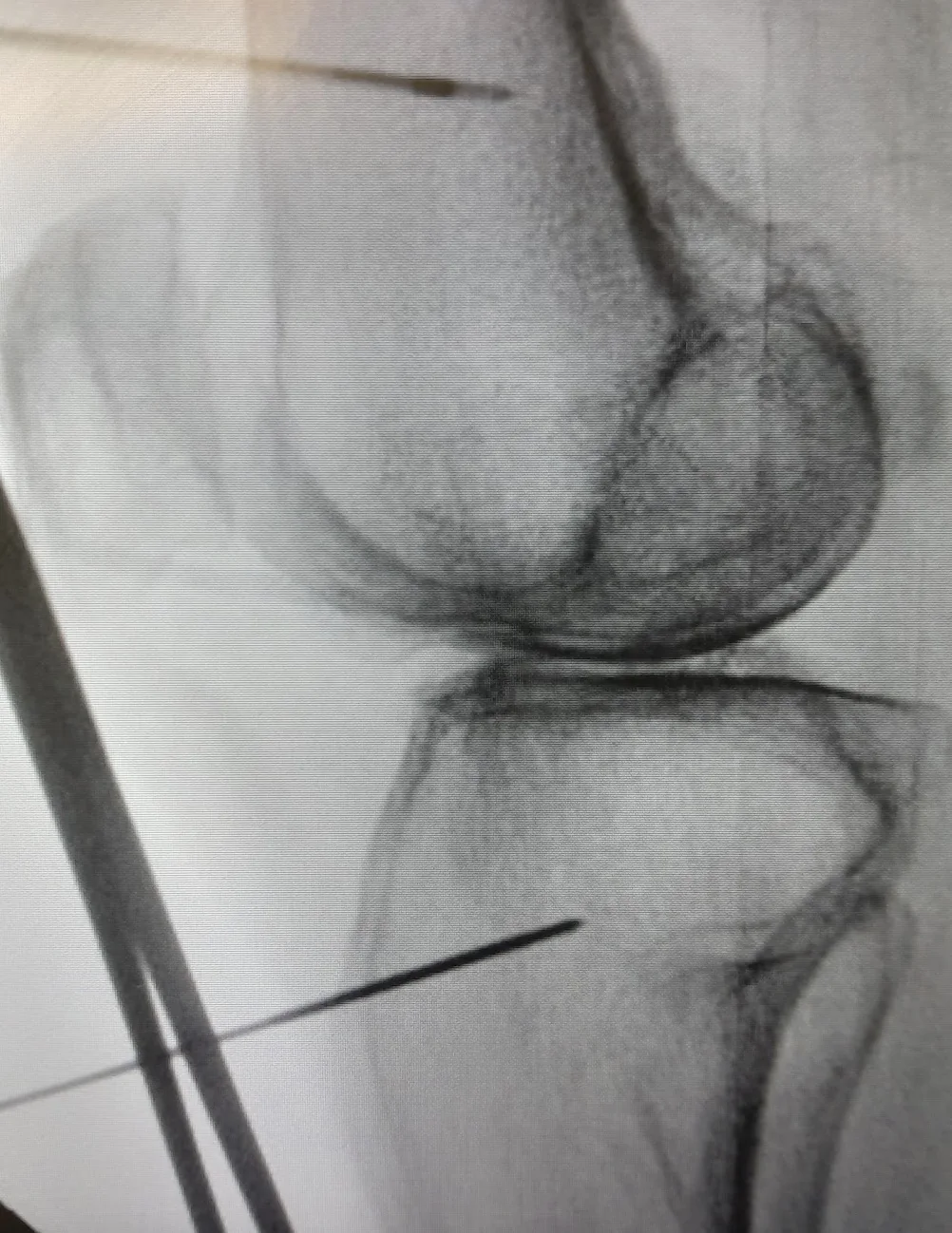
2Under X-ray guidance, the probe is placed beside a genicular nerve, one of the small sensory nerves that carry pain from the knee joint.
3The generator sends a controlled current to the probe, which warms its tip. Only the tip heats up.
4The heat interrupts the nerve, so it can no longer carry pain signals from the joint. The nerve can regrow over time, so the treatment can sometimes be repeated.
X-ray image of the knee from the side, with needles positioned beside the knee joint during genicular nerve radiofrequency ablation
X-ray (fluoroscopy) image taken during genicular nerve radiofrequency ablation of the knee. The needles are placed next to the nerves that carry pain from the joint.

What to expect at your visit

At your consultation, Dr Liu will ask about your symptoms, which joints are affected, your activities and your medical history, and examine the joint. He will explain what he finds, discuss whether any tests would help, and go through your treatment options, including their benefits, limits and risks, so that you can decide what suits you.

You do not have to put up with arthritis pain. Many people can ease their pain with the right treatment, and our aim is to help you get back to the things you enjoy. Book a consultation and we will work out a plan with you.

Living well with arthritis

  • Keep moving. Low-impact activity such as walking, swimming or cycling is good for your joints. Short, regular sessions work better than occasional long ones.
  • Keep to a healthy weight to reduce the load on your knees and hips.
  • Pace your day. Alternate activity with rest, and avoid long periods in one position.
  • Wear supportive, well-fitting footwear, especially if the knees, hips or feet are affected.
  • Use warmth on stiff joints, and keep up gentle strengthening for the muscles around them.
Dr Christopher Liu, pain physician at Alleviate Pain Clinic

Dr Christopher Liu, Pain Physician

MOH accredited Pain Specialist and Medical Director of Alleviate Pain Clinic at Farrer Park Hospital. He completed an interventional pain fellowship at the University Health Network in Toronto and was previously a Senior Consultant in Pain Medicine at Singapore General Hospital.

Read more about Dr Liu

References

  1. Kolasinski SL, Neogi T, Hochberg MC, et al. 2019 American College of Rheumatology/Arthritis Foundation guideline for the management of osteoarthritis of the hand, hip, and knee. Arthritis & Rheumatology. 2020;72(2):220–233. doi:10.1002/art.41142
  2. National Institute for Health and Care Excellence. Osteoarthritis in over 16s: diagnosis and management (NG226). 2022. nice.org.uk/guidance/ng226

This page gives general information and is not a substitute for medical advice. Please see a doctor about your own symptoms and treatment options.

Common questions

What is the difference between osteoarthritis and rheumatoid arthritis?

Osteoarthritis is gradual damage to the joint, more common with age, injury and excess weight, and tends to affect the knees, hips, hands and shoulders. Rheumatoid arthritis is an inflammatory condition in which the immune system attacks the joints, often affecting several joints on both sides of the body, with morning stiffness lasting more than about 30 minutes. It needs specialist drug treatment, usually from a rheumatologist.

Can arthritis be cured?

There is no cure for osteoarthritis, but there is a lot that can be done. Pain can often be eased with exercise, weight management, medicines, joint injections and, for some people, PRP or nerve treatments for the joint, and many people stay active for years. Inflammatory arthritis is treated with specialist medicines that control the immune system.

Do I need an X-ray or MRI for arthritis?

Often an examination is enough, and an X-ray is the usual first test. It shows joint space loss and bone changes, but the amount of change does not always match your pain. An MRI or ultrasound is used in selected cases, for example if another problem such as a tendon or cartilage injury is suspected.

What is joint denervation, and who is it for?

Joint denervation uses radiofrequency heat, guided by X-ray, to interrupt the small sensory nerves that carry pain from a joint, most often the knee, hip or shoulder. It may be considered for long-standing arthritis pain when medicines, exercise and injections have not helped enough, or when surgery is not suitable. Relief varies between people. The nerves can regrow, so the treatment can sometimes be repeated.

Will I need a joint replacement?

Many people with arthritis never need one. Joint replacement is usually considered for severe arthritis when pain and function remain poor despite other treatment. If you are unsure, an assessment can help you understand your options.

Does insurance cover interventional pain treatments in Singapore?

Interventional pain procedures are covered by the Ministry of Health's Table of Surgical Procedures (TOSP). They are therefore usually claimable under Integrated Shield Plans and most corporate insurance plans, subject to your plan's terms. However, it is advisable to obtain preauthorisation from your insurer before the procedure. Our clinic staff will guide you through this process.

Ready to talk about your pain?

Book a consultation, or call us on 8655 5722.
Go To Top