

Injections

Shoulder Hydrodilatation for Frozen Shoulder in Singapore

Shoulder hydrodilatation is a minimally invasive injection that stretches a stiff joint capsule, to reduce pain and help you move your shoulder again.

At a glance

What it isAn injection of a large volume of fluid into the shoulder joint, given under ultrasound guidance, to stretch a tight, stiff joint capsule.
Who it is forPeople with frozen shoulder who have significant pain and stiffness affecting sleep and daily tasks.
What to expectDone in the clinic, and most patients go home the same day. In our experience, many notice a big improvement soon after.
Not suitable ifYou have an active infection or an allergy to local anaesthetic or steroids. Extra care is needed with diabetes.
Written and reviewed by Dr Christopher Liu, Pain PhysicianLast reviewed: 28 October 2026About Dr Liu

What is shoulder hydrodilatation?

A frozen shoulder (adhesive capsulitis) occurs when the capsule surrounding the shoulder joint becomes tight, stiff and inflamed, causing pain and restricting movement.1 Hydrodilatation treats this problem directly.

A large volume of sterile saline and local anaesthetic, usually together with a corticosteroid, is injected into the shoulder joint under ultrasound guidance. The fluid pressure gently stretches the tight joint capsule from the inside and loosens the adhesions that cause stiffness. This helps to:

  • reduce pain and inflammation
  • improve the range of motion of the shoulder
  • make it easier to start the stretching exercises that are an important part of recovery

It can be done at any stage of frozen shoulder. To learn more about the condition itself, see our page on frozen shoulder.

Who is hydrodilatation for?

Hydrodilatation is suitable for people who have been diagnosed with frozen shoulder and have significant pain and stiffness. You do not need to have tried physiotherapy or medicines first. We often give the injection and teach you exercises at the same time.

Before the procedure, we assess your shoulder to confirm that frozen shoulder is the cause of your pain. Other conditions, such as a rotator cuff problem or arthritis, can look similar and may need a different treatment. Frozen shoulder is more common in people with diabetes,2 and we take extra care with blood sugar because steroids can raise it for a few days.

The procedure may not be suitable if you have:

  • an active infection anywhere in your body
  • a known allergy to local anaesthetics or steroid medication
  • poorly controlled diabetes, until your blood sugar is better controlled

What to expect

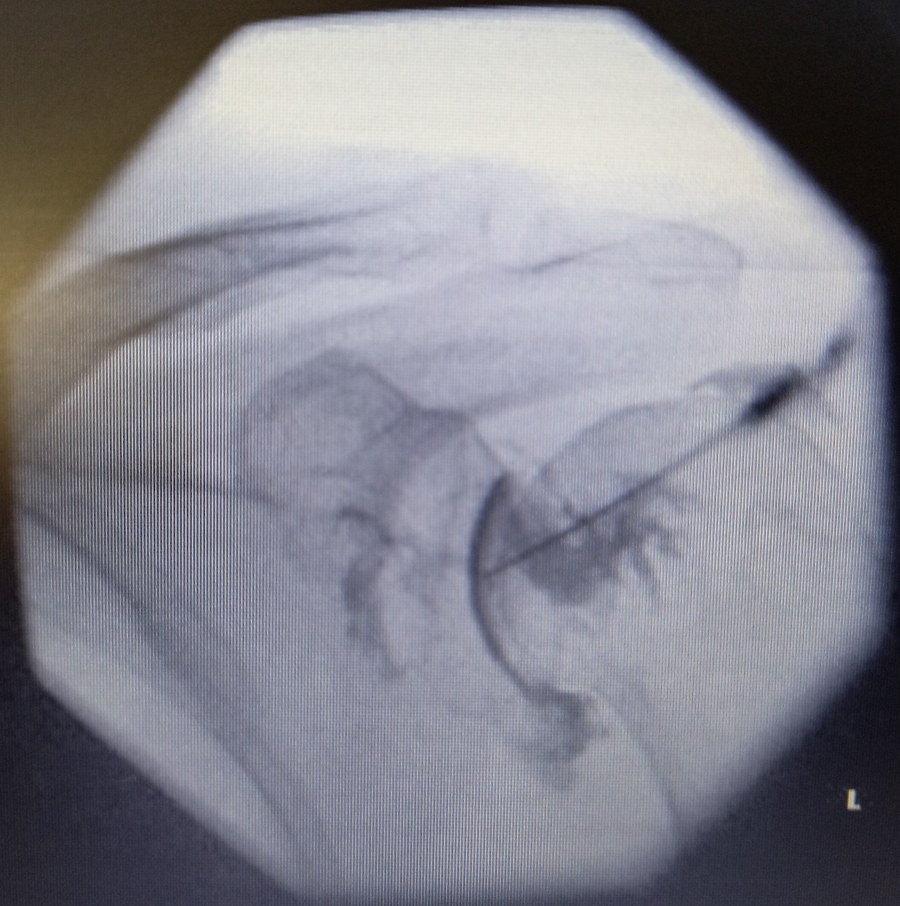
Hydrodilatation is an ultrasound-guided procedure that is usually done in the clinic. The skin is numbed first, and the needle is guided into the joint using ultrasound so the fluid goes to the right place. X-ray imaging is sometimes used instead. Local anaesthetic, saline and usually a steroid are used, and expert consensus supports image guidance and a gradual, comfortable injection volume.3

Fluoroscopic (X-ray) image of the shoulder joint taken during a hydrodilatation procedure, with a needle in the joint
Fluoroscopic (X-ray) image taken during a shoulder hydrodilatation procedure. The dark areas show contrast flowing within the shoulder joint as the needle delivers fluid under imaging.

As the fluid is injected, you may feel fullness or pressure in the shoulder. Most patients go home and return to normal activities on the same day. Your arm may feel heavy or numb for a few hours because of the local anaesthetic.

Stretching exercises after the injection are important, and expert consensus encourages home exercises and physiotherapy alongside hydrodilatation.3 We teach you a home programme and, if needed, arrange physiotherapy.

How well does it work?

In our clinical experience, most patients go home feeling much better, and many notice a big improvement in pain and movement soon after the procedure. The local anaesthetic wears off after a few hours and some soreness for a day or two is common, so we judge the full benefit over the following weeks, together with your exercises.

Results vary between people. In clinical studies, around seven in ten people had lasting improvement after a single procedure. In the others, a second injection may be required. Research shows that hydrodilatation relieves pain and helps movement in frozen shoulder, with benefits that are most clear in the early weeks.4 Frozen shoulder often improves on its own, but this can be slow and take up to 2 to 3 years, and some people have lingering symptoms. Treatment aims to ease the pain and restore movement sooner.

How many injections will I need?

Most patients need 1 to 2 injections for resolution of frozen shoulder symptoms. A second injection may be offered if the improvement is not complete, or if the symptoms return.

What does shoulder hydrodilatation cost in Singapore?

The cost depends on the treatment required. This is what a typical visit involves:

ServiceEstimated cost (SGD)*
First consultationfrom $210
Follow-up consultationfrom $155
Shoulder hydrodilatation (professional fee)from $350
Ultrasound usage fee (if applicable)from $150
Medications (if applicable)from $100

*Prices are indicative and may differ based on your condition, the setting (clinic or hospital), the medications used and whether image guidance is required.

In most circumstances, shoulder hydrodilatation is covered by insurance. If the cost of the procedure is under the minimum deductible for your insurance plan, most of the fees can also be covered by MediSave. Call us at 8655 5722 to find out more.

Possible risks and side effects

Side effects are usually mild and temporary. The most common are:

  • a feeling of fullness or pressure in the shoulder, which usually settles within hours
  • mild discomfort at the injection site for 1 to 2 days, and sometimes a short-lived flare of shoulder pain
  • minor bruising
  • facial flushing or a temporary rise in blood sugar after the steroid, particularly in people with diabetes

Serious complications such as infection, bleeding or an allergic reaction are very rare. The procedure is done in a sterile setting, and we will explain the risks to you before you decide.

Seek urgent medical care if you have shoulder pain with:

  • chest pain, breathlessness, sweating or pain spreading to the jaw or arm (this can be a heart problem)
  • a hot, red, swollen shoulder, especially with fever
  • severe pain or sudden loss of movement after a fall or injury

Go to the nearest emergency department.

Before your procedure

Please tell us if you:

  • have diabetes. We will advise you on monitoring your blood sugar after the steroid
  • take blood thinners. We will tell you whether any need to be adjusted
  • have any allergies, or have felt unwell or feverish recently

Bring any previous scans or reports of your shoulder. It helps to have someone accompany you, as your arm may feel numb or heavy for a few hours afterwards.

Looking after your shoulder afterwards

Rest the arm for the rest of the day while the local anaesthetic wears off, and avoid driving until it feels normal. From the next day, gentle stretching helps to keep the movement you have gained. Avoid heavy lifting until your doctor advises you. Contact the clinic if you develop fever, increasing redness or swelling at the injection site, or pain that is getting worse instead of better.

Understanding frozen shoulder

The exact cause of frozen shoulder is not fully understood, but it is believed to involve inflammation and thickening of the tissue around the joint. It often happens without any obvious reason. It can also develop after an injury or when the shoulder is kept still for a long time, such as when wearing a sling after a fracture. Diabetes and thyroid conditions can increase the risk.

People notice pain and stiffness that develops slowly. The pain is often worse at night, making it hard to sleep on the affected side. The condition usually progresses in stages, although not everyone goes through them in the same way:

  • Freezing stage (about 3 months): mainly pain, and the shoulder becomes harder to move.
  • Frozen stage (about 3 to 9 months): the pain starts to go down, but the shoulder stays very stiff.
  • Thawing stage: the shoulder gradually moves more easily and daily tasks get easier. There is a chance the problem could come back.

Pain and stiffness can overlap between stages.1 Frozen shoulder is diagnosed from your symptoms and a physical examination. Scans are not usually needed, but may be done if the diagnosis is unclear.

Read more on our frozen shoulder page.

Other treatment options for frozen shoulder

Most people with frozen shoulder improve with non-surgical treatment. Options include:

  • exercise or physiotherapy
  • hydrodilatation
  • corticosteroid injections into the shoulder joint (see hip, knee and shoulder joint injections)
  • pain-relieving medicines
  • manipulation under anaesthesia, where the shoulder is gently moved while you are asleep

In rare cases where these treatments do not work, surgery may be considered. We will help you choose the treatment that fits your stage of frozen shoulder and your goals.

Dr Christopher Liu, pain physician at Alleviate Pain Clinic

Dr Christopher Liu, Pain Physician

MOH accredited Pain Specialist and Medical Director of Alleviate Pain Clinic at Farrer Park Hospital. He completed an interventional pain fellowship at the University Health Network in Toronto and was previously a Senior Consultant in Pain Medicine at Singapore General Hospital.

Read more about Dr Liu

References

  1. Ewald A. Adhesive capsulitis: a review. American Family Physician. 2011;83(4):417–422. aafp.org
  2. Zreik NH, Malik RA, Charalambous CP. Adhesive capsulitis of the shoulder and diabetes: a meta-analysis of prevalence. Muscles, Ligaments and Tendons Journal. 2016;6(1):26–34. uclan.ac.uk
  3. Thompson H, Brealey S, Cook E, Hadi S, Khan SHM, Rangan A. Expert clinical consensus in the delivery of hydrodilatation for the management of patients with a primary frozen shoulder: a modified Delphi study. Bone & Joint Open. 2022;3(9):701–709. doi:10.1302/2633-1462.39.BJO-2022-0072.R1
  4. Poku D, Hassan R, Migliorini F, Maffulli N. Efficacy of hydrodilatation in frozen shoulder: a systematic review and meta-analysis. British Medical Bulletin. 2023;147(1):121–147. doi:10.1093/bmb/ldad018

This page gives general information and is not a substitute for medical advice. Please see a doctor about your own symptoms and treatment options.

Common questions about shoulder hydrodilatation

How many injections will I need?

Most patients need 1 to 2 injections for resolution of frozen shoulder symptoms. A second injection may be offered if the improvement is not complete, or if the symptoms return.

How soon will I feel better?

In our clinical experience, most patients go home feeling much better, and many notice a big improvement soon after the procedure. The local anaesthetic wears off after a few hours and some soreness for 1 to 2 days is common, so we judge the full benefit over the following weeks, together with your exercises. Results vary between people.

Is hydrodilatation painful?

The skin and joint are numbed with local anaesthetic. You may feel fullness or pressure as the fluid goes in, which is usually brief. Some soreness for 1 to 2 days is common.

How is hydrodilatation different from a steroid injection alone?

Hydrodilatation uses a larger volume of fluid, usually together with a steroid, to stretch the tight joint capsule from the inside. A steroid injection alone uses a small volume to reduce inflammation. Studies show at least as much pain relief overall, with hydrodilatation possibly improving everyday function sooner and helping you turn your arm outwards more. In our clinical experience, hydrodilatation followed by regular home exercises gives most patients a better and faster recovery, which is why we most often recommend it.

Will I need physiotherapy or exercises?

You do not need to try physiotherapy first. We often give the injection and teach you stretching exercises at the same time. Regular stretching after the injection is important for recovery, and we can arrange physiotherapy if you need more support.

Can hydrodilatation be done at any stage of frozen shoulder?

Yes. It can be done in the freezing, frozen or thawing stage. We will discuss the best timing for you based on your pain and stiffness.

Can I have hydrodilatation if I have diabetes?

Frozen shoulder is more common in people with diabetes, and many are treated with injections. The steroid can raise blood sugar for a few days, so please tell us you have diabetes. We will advise you on monitoring your blood sugar and whether the timing is suitable for you.

Can frozen shoulder come back after hydrodilatation?

Symptoms can sometimes return, and frozen shoulder can occasionally affect the other shoulder as well. If symptoms come back, a second injection may be offered, and we will review your exercises.

When can I return to my normal activities?

Most patients can return to normal activities on the same day. Your arm may feel numb or heavy for a few hours, so avoid driving until it feels normal. Avoid heavy lifting until your doctor advises you.

Does insurance cover interventional pain treatments in Singapore?

Interventional pain procedures are covered by the Ministry of Health’s Table of Surgical Procedures (TOSP). They are therefore reimbursable by all Integrated Shield Plans and most corporate insurance plans. However, it is advisable to obtain preauthorisation from your insurer before the procedure. Our clinic staff will guide you through this process.

Ready to talk about your pain?

Book a consultation, or call us on 8655 5722.
Go To Top